

edgeX Review: No-KYC Perpetuals, Global Markets, and Self-Custody
We believe in full transparency with our readers. Some of our content includes affiliate links, and we may earn a commission through these partnerships. However, this potential compensation never influences our analysis, opinions, or reviews. Our editorial content is created independently of our marketing partnerships, and our ratings are based solely on our established evaluation criteria. Read More



edgeX is the most convincing attempt we have seen in bringing the experience of a centralized derivatives exchange on-chain. It has the order book, deep liquidity, trading controls, mobile apps, and choice of markets that active traders expect – but it’s decentralized in all the right places, with users retaining control of their assets and starting with their own wallet or email address rather than completing Know Your Customer (KYC) checks.
The trading options on offer are the immediate attraction – alongside crypto perpetuals and spot markets, edgeX offers perpetual contracts linked to stocks, commodities, and forex. So a trader can move from Bitcoin or Ethereum into gold, oil, or a listed company without funding a separate brokerage account.
These are price-based derivatives rather than the underlying shares or commodities, but the convenience and ease of price trading is real.
Our edgeX review looks at how the platform works, what it is like to trade on, its fees, global markets, self-custody model, reward programs, and security record. More importantly, it asks whether edgeX offers enough over a centralized exchange to justify moving your trading on-chain.
About edgeX
edgeX is a decentralized, order-book-based exchange offering crypto spot trading and perpetual contracts linked to cryptocurrencies, stocks, commodities, and forex.
The platform launched in 2024 and has since moved from its original StarkEx-based V1 system to edgeX V2, a modular rollup built around faster execution and Ethereum-backed settlement. Circle Ventures is a strategic investor.

Users can connect a standard crypto wallet or automatically create an MPC wallet through an email login. No conventional identity verification is required, although regional restrictions still apply and perpetual trading is unavailable in the United States and certain other jurisdictions. But in broad terms, edgeX is available in 100+ countries.
Traders who fund on Circle’s Arc chain can use native USDC as margin and gas. They can also trade more than 150 perpetual markets from that account, including crypto, equities, gold, silver, and oil, as well as an on-chain JPY forex perpetual that remains open 24/7.
The platform is available through the web, iOS, and Android. Base perpetual fees at the time of writing are 0.04% for makers and 0.045% for takers, while spot fees begin at 0.04% and 0.07%.
Pros
- No mandatory KYC before trading
- Self-custodial deposits and withdrawals
- Crypto, stock, commodity, and forex markets in one app
- Fast, order-book-based perpetual trading
- Order latency below 100ms and peak throughput of 300,000 orders per second
- Web, iOS, and Android access
- Advanced orders, isolated margin, and sub-accounts
- Competitive perpetual and spot fees
- Public security audits and on-chain settlement
- Trade-to-Earn rewards, competitions, and Mystery Boxes
- 150+ perpetual markets (and new on-chain JPY forex perpetual) available via Arc
Cons
- Stock and commodity contracts do not provide ownership of the underlying assets
- Trading becomes more restrictive when the underlying stock and forex markets are closed
- Geographic restrictions can apply despite the lack of KYC
edgeX Features That Impressed Us the Most
edgeX works because it does not ask traders to accept a stripped-back interface in return for self-custody. The platform looks (and, most importantly, works) like a serious derivatives exchange, with a live order book, TradingView charts, market and limit orders, open-position controls, sub-accounts, and enough market depth to handle trades larger than the average retail order.
Depending on your background, that may sound like we are setting the bar low, but these features are one of the main dividing lines between decentralized and centralized trading. Many DEXs are easy to use for a swap but far less convincing when a trader needs precise order execution, multiple open positions, or a fast way to react to changing prices. edgeX has clearly been designed around people who spend time in front of a chart.

The range of markets reinforces that impression – crypto itself remains central, with perpetual contracts covering major assets and a separate spot market, but the platform has moved into deeper territory with separate stock, commodity, and forex perpetuals, each giving users access to markets that typically require a separate broker and a separate pool of capital.
We also like that edgeX offers different ways onto the platform – experienced crypto users can connect a wallet, while someone who does not want to manage a browser extension can log in with an email address and use an MPC wallet. That doesn’t turn derivatives trading into a product for beginners, but it removes one of the clumsier and hardest parts of starting with a decentralized exchange, and is perhaps why more than 500,000 traders use the platform.
The result is a platform that feels coherent, and where the mobile apps are not treated as an afterthought, and the tools are integrated into the main interface rather than scattered across separate products.
It is still possible to get lost if you have never traded perpetuals before, but active traders should find most controls where they expect them.
Perpetual Trading Without the Usual DEX Pain Points
Perpetual futures are the central feature of edgeX – contracts allow traders to take long or short positions on an asset without an expiry date, using collateral rather than paying the full value of the exposure upfront. Funding payments between long and short traders help keep the contract price close to its reference market.
edgeX uses an order book rather than an automated market maker, so buyers and sellers place orders at selected prices, while market orders execute against the liquidity already available. This is closer to the system used by a centralized exchange and generally gives an active trader more control over execution.

The V2 matching engine reports latency below 100ms and peak capacity of 300,000 orders per second, which should comfortably cover most orders, depending on factors such as liquidity, order type, and market conditions.
The difference from slower on-chain interfaces is obvious – placing or adjusting an order feels more like using a centralized exchange, where there’s no repeated wallet prompts or gas charges.
The platform’s standard controls cover market, limit, and conditional orders: a market order prioritizes entering or exiting a position immediately, accepting the best available price.
A limit order allows the trader to set a price, but it may remain unfilled if the market never reaches it.
More detailed instructions include:
- Fill-or-Kill, which requires an order to be completed immediately or canceled;
- Immediate-or-Cancel, which fills the available portion and cancels the rest;
- Good-Till-Time, which can leave an order open for up to four weeks.
Post-only orders guarantee that an order is placed on the book as a maker rather than immediately taking liquidity, while reduce-only orders prevent a closing trade from accidentally opening a new position in the opposite direction.
Take-profit and stop-loss orders are available, along with trailing controls that can move as the market moves. Conditional market and limit orders remain inactive until a trigger price is reached. Time-weighted average price orders give traders a way to divide a larger position into a series of smaller executions instead of sending the entire order to the book at once.
All in all, there’s plenty for everyone, especially someone running several strategies, and the tools are presented without making the main order panel feel complicated. A trader who only wants a limit order and a stop-loss can ignore most of the advanced settings, but someone who needs more control does not have to leave the platform to find it.
Crypto, Stocks, Commodities & Forex in One Account
The multi-asset range is edgeX’s clearest point of difference – crypto traders can access established markets such as Bitcoin, Ethereum, XRP, Solana, and Dogecoin, then move into contracts linked to precious metals, oil, foreign currencies, or listed companies without leaving the exchange.
This is particularly well-suited for traders who work across markets rather than remain permanently in crypto. Gold may become more interesting during a period of geopolitical stress, while a trader watching Asian technology companies can take a position without opening another brokerage account. Collateral, trading, and settlement remain within the same edgeX environment. Users who fund on Circle’s Arc chain can do so in native USDC across more than 150 perpetual markets in crypto, equities, gold, silver, and oil, plus a yen FX contract that stays open around the clock.

Do keep in mind that these products are perpetual contracts – buying a stock perpetual does not make the trader a shareholder. There are no voting rights, share certificates, or direct ownership of the company, and the position is not protected in the same way as stock held through a regulated broker. The trader is taking a leveraged position on price movement.
The lack of an expiry date makes these contracts easier to manage than dated futures, but it does not make them cost-free to hold. Funding payments can work for or against a position depending on which side of the market is more crowded, and a trade that remains open for weeks can accumulate a meaningful funding cost even if its price moves relatively little.
edgeX keeps its stock perpetual markets open around the clock, including weekends and holidays. This sounds like unrestricted access, although the rules change when the underlying stock exchange is closed. Market orders are rejected during those periods, leaving limit orders as the main option, and edgeX restricts how far prices can move from the previous closing index.
These controls are in place because the contract remains active even when the underlying shares may not be trading. With no live stock market providing fresh price discovery, liquidity can become thinner, and an edgeX contract can move away from the last official price. Traders should not assume that a weekend stock perpetual carries the same liquidity or exit options as the same contract during normal market hours.
Forex contracts receive similar treatment, in that edgeX classifies the underlying currency market based on its liquidity, tightening risk limits around daily rollover periods and the weekly open and close. When the conventional forex market is closed, new directional positions are restricted, and only reduce-only orders are permitted.
We think edgeX handles this sensibly – it would be misleading to advertise 24/7 access without acknowledging that the reference markets still close. So the platform keeps positions manageable during those periods while applying controls when the external liquidity is harder to find.
Margin, Leverage, and Sub-Accounts
edgeX uses cross-margin by default – available collateral is shared among positions within a trading account, allowing profits and unused margin in one part of the portfolio to support another position. This can make capital more efficient, particularly for traders holding several offsetting positions (although it also connects their risks – it is useful when it is deliberate, but can be unpleasant when a trader assumes each position is isolated).
The sub-account system provides a cleaner way to separate strategies, so a single wallet can create up to 20 trading accounts, each with its own margin. A liquidation in one does not automatically liquidate positions in another, and traders can keep higher-risk ideas away from a larger balance.
Sub-accounts also allow long and short positions in the same market, meaning that a trader can hold one direction in one account and the opposite direction elsewhere. Transfers between accounts are free, and their volume is combined when edgeX calculates the user’s trading-fee tier.
How edgeX Considers Speed vs. Self-Custody
The central trade-off in a decentralized order-book exchange is speed. Sending every new order, cancellation, margin update, and position change directly through Ethereum would be expensive and far too slow for active trading. Removing the blockchain completely would produce a fast exchange, but it would leave the operator in control of customer assets.
So edgeX sits somewhere between those two models – the latest V2 uses a dedicated execution environment to process orders, run risk checks, and clear trades. Transactions are batched before commitments are then settled through its rollup infrastructure and then anchored back to Ethereum. The platform currently uses the Arbitrum technology stack as part of that process.
For the trader, this means orders behave more like those on a centralized exchange (in particular, they are faster, and there are no separate gas payments or wallet approvals every time a limit order is moved). The underlying account state and asset movements remain tied to smart contracts rather than an internal company database.
The exchange describes itself as self-custodial because users authorize deposits and withdrawals with their own keys – assets are not held inside a conventional exchange wallet that the operator can freely access. Even if the front end becomes unavailable, the rollup design is intended to provide a route for users to recover assets through the underlying contracts.
That does not make every part of edgeX decentralized, in that the platform still uses a sequencer and off-chain matching infrastructure, and traders do rely on those systems to submit and execute orders normally. The more accurate description is a hybrid model: centralized-exchange-style performance combined with on-chain custody and settlement.
We see that as a practical choice rather than a contradiction – most active traders are unlikely to accept slow execution simply because it occurs entirely on-chain. What matters is being clear about which parts of the system require trust and which protections remain available if the operator encounters problems.
On the safety side, there’s a range of audit results for the V2 platform, including audits by Halborn, Zellic, Spearbit, and SlowMist.
Spot Trading, eStrategy, and Rewards
Perpetuals dominate the platform, but edgeX also includes crypto spot trading, so you have a way to buy and sell supported assets without leverage, liquidation, or ongoing funding payments. It is also convenient for moving between stablecoins, EDGE (the platform’s governance token, which we come to later), and other listed tokens without transferring funds to another exchange.
Base spot fees are 0.04% for makers and 0.07% for takers – higher than edgeX’s perpetual rates on the taker side, but below the 0.1% base fee commonly charged by major centralized exchanges.
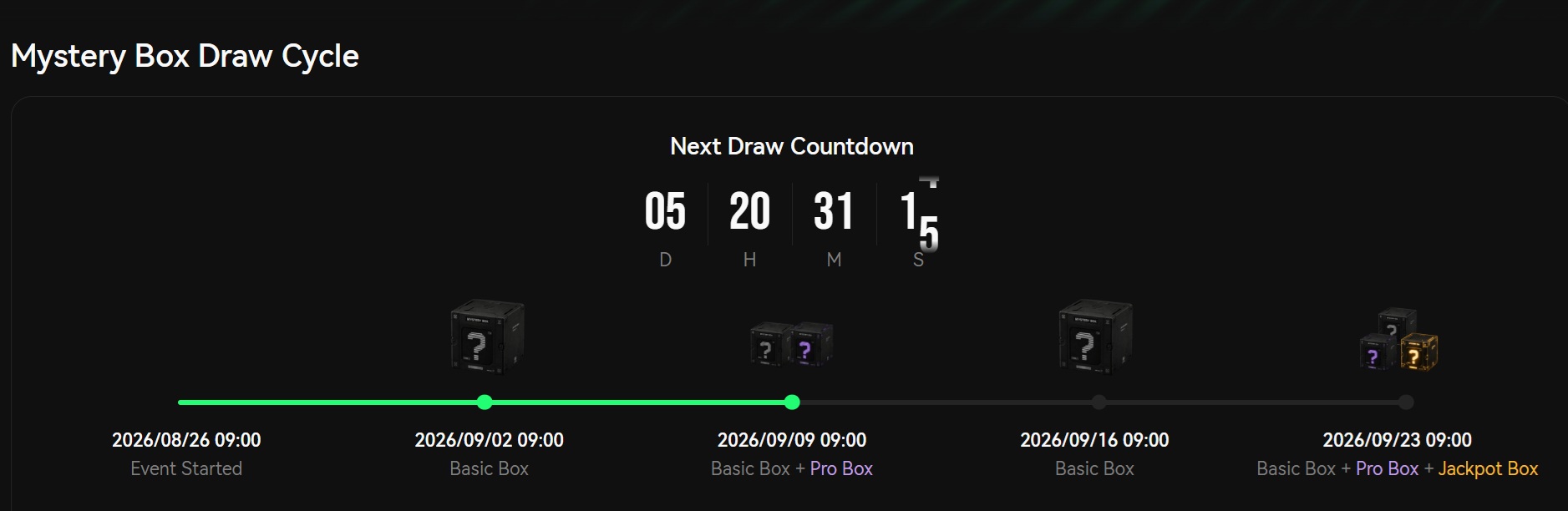
edgeX also runs Trade-to-Earn campaigns, competitions, and weekly Mystery Boxes. The exact offers change, but the system provides weekly rewards to users based on eligible trading activity. We saw campaigns that returned rebate fees and competitions that divided a fixed pool between qualifying traders.
Mystery Boxes provide a more playful layer – under the current campaign, accumulating 150,000 USDC in valid trading volume can qualify a user for a Basic Box. Possible prizes include USDC, EDGE, electronics, and luxury items, with a potential 300,000 USDC grand prize awarded to one winner.
EDGE is often the token behind the reward system and wider ecosystem. It has a fixed original supply of one billion tokens, with allocations for early users, liquidity, the foundation, contributors, and future development. edgeX uses part of its revenue to buy EDGE from the market and burn it. At the time of our review, its public dashboard showed 48.12 million tokens burned, equal to 4.81% of the original supply.
edgeX Fees at a Glance
edgeX charges different rates to makers and takers. Maker orders add liquidity by resting on the order book, while taker orders execute against existing liquidity.
| Transaction | Base Cost |
| Perpetual trading – maker | 0.04% |
| Perpetual trading – taker | 0.045% |
| Spot trading – maker | 0.04% |
| Spot trading – taker | 0.07% |
| Internal sub-account transfers | Free |
| Standard Ethereum withdrawal | Network gas fee |
| Non-Ethereum cross-chain withdrawal | 0.1%, minimum $1 |
| Trading settlement gas | Covered by edgeX |
| Perpetual funding | Variable by market |
Higher-volume traders can qualify for lower rates through the VIP system. These can change over time, so here’s the link to the current rates, or a handy image accurate at the time of writing.
Who Is edgeX Best For?
For us, edgeX is best suited to traders who already understand perpetual futures and want to reduce their dependence on centralized custody. It provides plenty of depth, order control, and market choice, making it your main derivatives platform rather than a secondary DEX account for one or two tokens.
The exchange is particularly appealing to multi-asset traders – someone who follows crypto alongside gold, oil, forex, or international stocks can keep those positions within one stablecoin-funded account. While we tested mainly on desktop, the mobile apps make the platform easier to monitor away from a desktop, and sub-accounts provide a sensible way to keep strategies separate.
The ability to trade without KYC will appeal to privacy-conscious users and people who do not want to submit identity documents to another exchange. That does not override local law or the platform’s restrictions, and users remain responsible for checking whether the products are available where they live. In simple terms, you can be up and running in a few minutes.
Complete beginners should approach more carefully – email onboarding makes the account easy to create, but it does not simplify funding, leverage, liquidation, or self-custody, so trade at your own skill level. A first-time trader may find a conventional spot exchange easier, particularly if they want bank payments or just a simple way to buy and hold crypto.
There is still a reasonable route in for less experienced users: begin with spot, use a separate sub-account for any derivatives, keep leverage low, and place a small trade before moving a larger balance.
Conclusion
edgeX deserves to be on any DEX user’s list, because it gets the core trading experience right. Orders are fast, the interface is familiar, the services are unusually broad, and there are pretty much all of the advanced controls you can need. Its stock, commodity, and forex perpetuals are a genuine advantage.
We also like the way edgeX approaches self-custody: the platform does not pretend that every part of high-speed order matching can happen directly on Ethereum. It uses a dedicated execution system for speed, then brings custody and settlement back on-chain. That model retains some dependence on edgeX infrastructure, but it is more practical for active trading than waiting on blockchain confirmation for every order.
edgeX is one of the strongest decentralized exchanges we have used for perpetual trading and one of the few that can plausibly replace a centralized derivatives account rather than just sit alongside it.
Visit edgeXFAQs
What is edgeX?
Does edgeX require KYC?
Is edgeX really decentralized?
What can you trade on edgeX?
Is edgeX suitable for beginners?
Is edgeX safe?
Does edgeX offer markets on Arc?
2M+
250+
8
70





 in numbers

