- $72,580 median depth near the price
- Resting limit orders free on most markets
- Market data API needs no key to read
Kalshi Overview
- Prediction Market Name
- Kalshi
- Platform Type
- Regulated Event Exchange
- Fun Play Mode
- No
- Regulated
- Yes
- Availability
- U.S. users, except where court orders block contracts (most contracts in Nevada and Washington, sports in Michigan), plus most countries outside Kalshi's 55 restricted jurisdictions
- Age Requirement
- 18+ (age of majority where you live: 19 in Alabama and Nebraska, 21 in Mississippi)
- KYC Level
- Full KYC
- Funding Currency
- USD
- Minimum Deposit
- $10 ($1,000 by wire)
- Core Market Categories
- Elections, sports, entertainment, politics, financials, economics, science and technology, climate and weather, companies, mentions, crypto, commodities
- Contract Type
- Multi-Outcome Contracts, Binary Contracts, Range Contracts
- Liquidity Model
- Order Book
- Early Exit
- Yes
- Position Limits
- Yes
- API / Historical Data Access
- Yes
- App Availability
- iOS, Android, Web-Based
- Tax Reporting
- Yes
Kalshi Screenshots


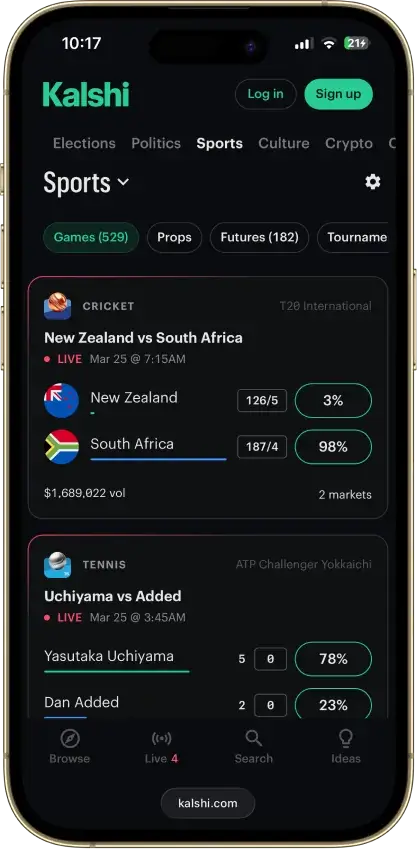


Screenshot 1 of 8
Kalshi Pros and Cons
Pros
- 1¢ spreads on top election and sports markets
- 8,000+ open events across 17 categories
- Free ACH, wire and RTP deposits
- Debit withdrawals land within hours
- Full API with WebSocket and FIX
Cons
- Court orders block contracts in 3 states
- Disputed outcomes can't be appealed
- Card deposits can cost up to 2%
- No phone support, AI chat first
- No tax form named for trading gains
Who Kalshi Is Best For — And Who Should Skip It
Among the prediction markets we rate, Kalshi fits traders who get in and out of positions with resting limit orders, which are fee-free on almost every market. Its busiest election and sports markets trade at a 1¢ gap between the best bid and ask, and debit withdrawals usually land within hours. Election traders get the largest selection, macro traders get markets on rates, inflation and jobs data, and developers get a public API with WebSocket and FIX access.

It fits badly if you live in Nevada or Washington, where court orders block most of its contracts, if you mainly trade sports from Michigan, if you need to reach a person by phone, or if you want a formal right to appeal a settlement. Traders who want a crypto wallet workflow will find Polymarket closer to that, and existing brokerage customers can reach many of the same contracts through Robinhood's event contracts.
| Category | Fit | Why |
|---|---|---|
| Casual Events | Medium | $10 minimum, full ID check |
| Sports | High | 1,904 events, 1¢ spreads |
| Macro Or Economic | High | 1,069 events |
| Politics | High | 3,384 election events |
| Crypto-Native | Low | USD only, 44 crypto events |
| API Or Bot | High | REST, WebSocket, FIX |
| Fast Cash-Out | High | Debit in hours, crypto in 30 min |
| Low KYC Friction | Low | Photo ID, repeat checks |
| Clear Regulation | High | CFTC exchange since 2020 |
What Is Kalshi And How Does It Work?
KalshiEX LLC runs Kalshi as a CFTC-designated contract market, a futures exchange for event contracts, and every trade clears through Kalshi Klear LLC, a clearing house Kalshi owns. A standard contract pays $1 if its event happens and $0 if it doesn't, and market rules can set another value in rare cases, so a Yes price of 62¢ reads as a 62% chance.

Trading takes five steps:
- Open an account and pass the ID check
- Deposit dollars by debit card, Apple Pay, Google Pay, bank transfer, PayPal, Venmo, Cash App, crypto, wire or Real-Time Payments
- Buy Yes or No contracts at the market price or with a limit order
- Sell before the market closes, or hold until it settles
- Withdraw to a debit card, bank account, PayPal, Venmo, crypto wallet or, for large amounts, by wire
Every trade matches you with another member of the exchange. Kalshi itself never takes the other side, though an affiliate, Kalshi Trading LLC, trades as a member under Kalshi Rule 2.12, which bars it from Kalshi's non-public order-flow and settlement information. Most members are retail traders, and market makers are mostly individuals and small firms. Other firms route their customers to the same order book, including Coinbase's prediction markets, which run entirely on Kalshi contracts.
Kalshi also lists perpetual futures for approved U.S. users through a separate broker, Kalshi Prime, and they're outside this review and its score.
Is Kalshi Legit?
Yes, Kalshi is a legitimate, federally regulated exchange. The CFTC designated KalshiEX as a contract market in November 2020, and its clearing house, Kalshi Klear, has been a CFTC-registered derivatives clearing organization since August 2024. Where it can operate is a different question, and courts are deciding it state by state.
| Role | Entity | Registration |
|---|---|---|
| Exchange | KalshiEX LLC | CFTC contract market, 2020 |
| Clearing house | Kalshi Klear LLC | CFTC clearing organization, 2024 |
| Broker | None | Accounts clear directly |
| Customer funds | Kalshi Klear account at SVB | Segregated, no FDIC guarantee |
States argue that sports and election contracts are unlicensed gambling under state law, and federal courts have split on whether federal regulation overrides those state gambling laws. The Third Circuit sided with Kalshi in New Jersey, and New Jersey asked the U.S. Supreme Court to take the case on September 2, 2026. The Ninth Circuit ruled against Kalshi's sports contracts in Nevada on August 28, 2026, and Kalshi asked for a rehearing on September 9. About 20 states are in litigation with Kalshi, and three have orders in force that block contracts:
- Nevada: a state court injunction blocks sports, election and entertainment contracts, with IP, residency and third-party location checks required.
- Washington: an August 13, 2026 King County order blocks sports, elections, politics, entertainment, culture, tech and science, and mentions contracts.
- Michigan: an Ingham County injunction signed September 1, 2026 requires location blocking of sports contracts, with a $500,000-per-day fine for violations.
Other cases are live without an order against Kalshi in force. New York's attorney general sued on July 31, 2026, asking a court to stop all event contracts nationwide and seeking more than $36 billion in damages, and a CFTC emergency order directs Kalshi to keep operating while that plays out. Two class actions over the Khamenei market are pending in New York federal court, with Kalshi's motion to move them to arbitration undecided.
For a trader asking whether Kalshi is safe, that means a regulated exchange with segregated funds, and a list of available contracts that changes with each court order. The state cases concern which contracts Kalshi may offer, not the money in its accounts.
Access, Eligibility and Account Setup
Kalshi accepts traders who are 18 or older and have reached the age of majority in their state, which is 19 in Alabama and Nebraska and 21 in Mississippi. Every account needs an ID check with a driver's license or passport. The app asks for a live photo of the physical ID and sometimes a selfie. Occasionally it also asks for proof of address, employment or source of funds. Verification usually takes a few minutes, and accounts sent to manual review are typically cleared within 48 hours. A Social Security number isn't needed to deposit, trade or withdraw by non-crypto methods, though Kalshi asks for one to pay interest or report credits for tax.

U.S. State Availability as of September 2026
Trading From Outside the U.S.
Kalshi accepts traders outside the U.S. except in 55 listed jurisdictions, including Australia, Belgium, Canada, France, Singapore and the U.K., along with U.S.-sanctioned territories. The list is in Section VI of the Kalshi Member Agreement, last changed June 22, 2026. International accounts deposit by debit card, crypto or wire and withdraw by debit card or crypto. Bank transfers, PayPal, Venmo and Cash App are U.S.-only. Travel is allowed as long as you aren't located in a restricted jurisdiction when you trade.
A trader with ID ready and a debit card can usually place a first trade the same day. A bank deposit is often partly credited at once, with the rest arriving when the transfer settles within 5 business days.
Market Coverage and Contract Design
Kalshi had more than 8,000 open events across 17 categories in September 2026. Elections leads, and our live election markets track many of the same races. Traders who only want U.S. politics can compare PredictIt, a politics-only market with a cap on each contract position.

Kalshi's sports markets are the second-largest group, with 1,904 open events. Entertainment, financials, economics and a long tail of weather, company and science questions make up the remaining events.
| Category | Open Events | Examples |
|---|---|---|
| Elections | 3,384 | Races, party control, primaries |
| Sports | 1,904 | Games, props, season futures |
| Financials and Economics | 1,069 | Rates, inflation, jobs data |
| Entertainment | 609 | Awards, box office, music |
| Politics | 589 | Policy, appointments |
| Other | About 440 | Weather, companies, crypto, AI |

Contract Design Notes
- Binary Yes/No: the default. A market normally pays $1 or $0, and the exceptions are set in its rules.
- Multi-outcome groups: sets of mutually exclusive markets with one winner.
- Range and threshold ladders: above, below and between strikes on economic data, prices and weather.
- Combos: custom multi-leg positions priced by request for quote. A combo pays up to $1, fills only if another member quotes it, and can't be canceled once filled. If an athlete in a combo never enters the game, that leg settles at a last fair price set by the exchange, not at $0 or $1.
- Hours: trading runs 24/7 except for a Thursday maintenance window from 3:00 to 5:00 AM ET.
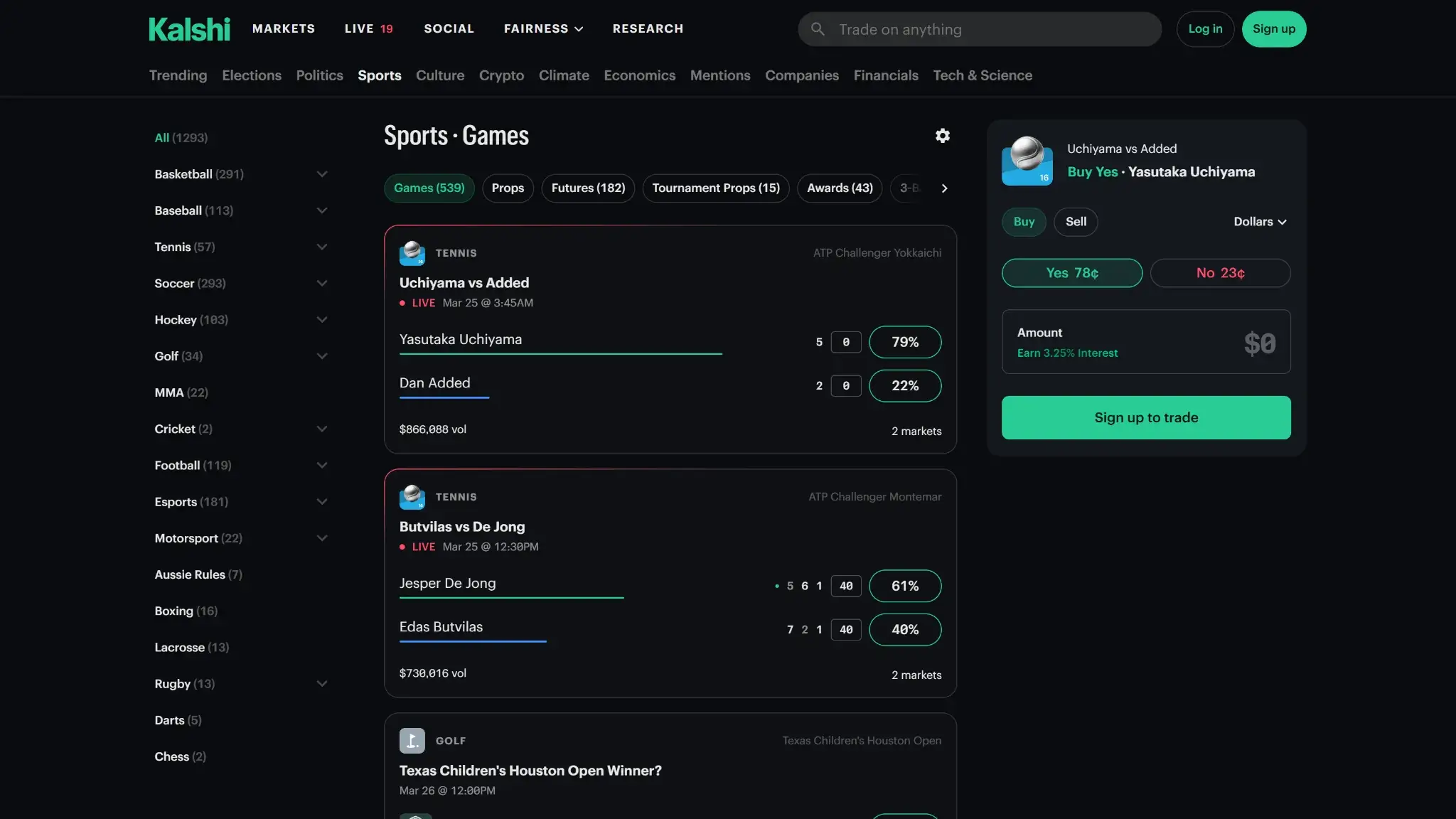
Liquidity, Order Book and Execution Quality
Across the 12 busiest election and sports markets priced between 10¢ and 90¢ on September 23, 2026, every one had a 1¢ spread, and the median dollar value resting within 2¢ of the mid price was $72,580. In most of them, an order of a few thousand dollars fills at or near the quoted price.
| Market | Spread | Depth Within 2¢ |
|---|---|---|
| Texas Senate, Republican | 1¢ | $271,351 |
| Rams win 2027 NFL title | 1¢ | $242,189 |
| Bills win 2027 NFL title | 1¢ | $156,936 |
| Democrats win Senate | 1¢ | $140,802 |
| Indiana wins CFP title | 1¢ | $88,271 |
| Republicans win Senate | 1¢ | $81,658 |
| Texas Senate, Democrat | 1¢ | $63,502 |
| Florida governor, Republican | 1¢ | $54,131 |
| Josh Allen wins MVP | 1¢ | $49,072 |
| Democrats win both chambers | 1¢ | $48,310 |
| Barcelona wins Champions League | 1¢ | $4,412 |
| Giants make playoffs | 1¢ | $1,521 |
Depth varies widely even inside the top 12. The Giants playoff market had $1,521 within 2¢ of the price, against $271,351 on the Republican side of the Texas Senate race, so an order of a few thousand dollars there would move through several price levels. A limit order caps your price instead of walking the book. Resting orders pay no fee on 14,128 of Kalshi's 14,288 series, and only 160 charge a maker fee. Canceling a resting order is free as well. Partial fills are normal, and you can sell before resolution on any open market with a bid.
Traders report failed sell orders during fast-moving live events. Separately, Kalshi can review and cancel trades executed at prices it considers erroneous, and it announces those reviews in public exchange notices.
Fees and Total Cost to Trade
Kalshi charges a fee on each trade that peaks at a 50¢ price and falls toward zero near 1¢ or 99¢. The standard taker fee is 0.07 × contracts × price × (1 − price), which comes to 1.75¢ per contract at 50¢. Fees are calculated to a millionth of a dollar, and rounding overpayments are rebated within the order, so small orders don't pay a rounding penalty.
The taker fee applies to orders that match immediately, and the maker fee only to resting orders that fill on the few series that charge one. On combo trades, when no order has rested for more than 5 seconds, the trader pays the taker fee and the quoter pays the maker fee, a rule in effect from July 24, 2026 at the earliest.
Take 100 Yes contracts bought at 50¢. Buying them costs $50 plus a $1.75 fee. Selling them at 60¢ returns $60 minus a $1.68 fee. The price move made $10, and fees took $3.43 of it, leaving $6.57. Funding by bank transfer instead of a card keeps the 2% card fee off the deposit.
Funding, Settlement and Cash-Out Flow
Kalshi has a $10 minimum deposit and a $1,000 minimum for wires. Winnings land in your cash balance when a market settles, usually within about 3 hours of the outcome. Settlement waits for the source named in the market's rules, so a market can stay open after an event appears to be over.
Deposits
| Method | Minimum | Arrives | Fee |
|---|---|---|---|
| Debit card, Apple Pay, Google Pay | $10 | Instant | Up to 2% |
| Bank transfer (ACH) | $10 | Up to 5 business days | Free |
| PayPal, Venmo | $10 | Instant | Free once, then up to 2% |
| Cash App | $10 | Instant | Fee applies |
| Crypto | $10 | Up to 30 minutes | Network fees |
| Wire | $1,000 | Same day | Free |
| Real-Time Payments | $10 | Minutes | Free |
Bank transfers are often partly credited at once, with the rest arriving when the transfer settles. Wires count the same day if Kalshi receives them by 4 PM ET.
Withdrawals
| Method | Arrives | Fee |
|---|---|---|
| Debit card, Apple Pay, Google Pay | Within a few hours | Free |
| Crypto | Within 30 minutes | Free |
| Bank transfer (ACH) | A few business days | Free |
| PayPal, Venmo | Not disclosed | Free |
| Wire | Not disclosed | Free |
Card and bank deposits can't be withdrawn until they settle, and taking them out by a different method can add up to 2 days. PayPal, Venmo, Cash App, crypto and wire deposits carry no hold. Holds cover only the amount you deposited, so settled winnings can be withdrawn straight away. A crypto withdrawal needs a prior crypto deposit, and wires are the route Kalshi points to for amounts above $500,000. A daily withdrawal limit is set per account and rises with activity. U.S. accounts with a balance of $250 or more also earn 3.25% variable interest on cash and open positions.
The friction traders report most is a withdrawal paused while the account goes through another ID check. Kalshi runs routine compliance checks after sign-up and can restrict account functions until they're done. Card withdrawals can also pause for 3 to 5 business days during a payment-processor review. Keeping your ID and payment names identical to your account name avoids one common trigger.
Resolution Rules, Market Integrity and Disputes
Every Kalshi market names the source that decides it, such as an official league, a government data release or a news organization, and Kalshi's markets team settles it from that source. If a trader thinks a market should settle, the Request to Settle option flags it for review. When an outcome is unclear, Kalshi's Outcome Review Committee decides within 24 hours. The committee's decision is final, and individual traders can't appeal it.
Four cases from the past year show how that works in practice:
- Western Michigan vs. Michigan, September 2026: Kalshi settled its market on the September 5 college football game as a Western Michigan win before the game was over. The officials restored one second to the clock, and Michigan won. Kalshi reversed the result, took back the Western Michigan payouts, refunded the traders who had backed Michigan and then paid them as winners.
- Khamenei, March 2026: the markets on Ali Khamenei leaving office carried a rule that his death would settle positions at the last traded price. Kalshi paused trading, said it would reimburse losses from trades placed while an earlier wording of the rule was ambiguous, and settled the four open markets on March 1, 2026 at $0.02, $0.29, $0.45 and $0.51. Two class actions over the market are pending.
- White House Correspondents' Dinner, April 2026: after the dinner was interrupted, Kalshi paused the markets, amended its rules with immediate effect and settled all 44 mention markets at last-traded prices, $0.01 to $0.55, rather than $0 or $1.
- NBA season awards, March 2026: Kalshi changed the deadline in ten award markets from April 12 to August 31, 2026 after they were listed, to match the settlement period traders understood the contracts to cover.
Kalshi posted a notice or a CFTC filing for each case. Even so, rules can change after a market opens, and the exchange has the last word. Traders report disputes over how markets settled, especially combos.
Kalshi bans anyone with non-public information about an event, or any influence over it, from trading its contracts, and many markets list extra prohibited groups such as campaign staff. Kalshi published 11 disciplinary actions in 2026, most against candidates who traded on their own races, with suspensions of up to five years and fines.
Security, Custody, Privacy and Trust
Customer cash at Kalshi is held in Kalshi Klear's settlement account at Silicon Valley Bank, a division of First Citizens Bank, segregated under CFTC Part 22 rules that protect it if a clearing member or clearing house fails. The account includes an insured cash sweep, but it isn't in your name, so FDIC cover isn't guaranteed to you. New deposits may also be outside the sweep for two business days. Whether your money is safe at Kalshi comes down to that segregation rule and the sweep. The companies behind the product are listed in the entity table above.
Two-factor authentication is on by default, with an authenticator app as an option. ID images are checked by a third-party verification provider, and Social Security numbers are stored encrypted. Account records can't be fully deleted, since a regulated exchange must keep them. Kalshi runs bug bounty programs for both its apps and its market rules.
UX, Apps, Automation and Data Access
Kalshi trades on iOS, Android and the web, with the iOS app updated on September 21, 2026. The app adds a combo builder and a community feed on top of the markets. A demo environment at demo.kalshi.co lets you practice with test funds before depositing.
For automation, Kalshi offers a REST API, WebSocket streams and a FIX connection, with public market data through its API available without a key, and historical endpoints for settled markets. API rate limits rise through usage tiers earned by trading volume.
Taxes, Statements and Record-Keeping
Kalshi issues four tax forms when IRS thresholds are met: 1099-INT for interest, 1099-MISC for credits and rewards over $600, 1099-B for proceeds from crypto transfers, and 1099-DA for digital-asset reporting through Zero Hash. None of the four covers gains from trading event contracts, so reporting tax on prediction-market gains depends on your own records. A yearly profit-and-loss statement, calculated first-in-first-out and including fees, updates on the first of each month.
Customer Support, Limits and Incident Handling
Support runs through an in-app and web chat that starts with an AI assistant and hands off to a person when needed. Email is reserved for people who can't use the chat. There's no phone or text support, and no response time is stated. Traders report slow handoffs to a human, including when a withdrawal is paused for a compliance check.
Position limits apply per contract, and designated market makers can get adjusted limits. Incidents run through public exchange notices. Kalshi pauses a market under Rule 13.1 when an event is disrupted, reviews or cancels trades at erroneous prices under Rule 5.11, and has offered to reimburse traders after rewording an ambiguous rule mid-market, as with the Khamenei clarification.
Final Verdict
Kalshi earns an 8.1 under our prediction-market scoring, on the strength of its order book. Its busiest markets trade at 1¢ spreads with tens of thousands of dollars near the price, it lists more than 8,000 events, and money moves in and out free by bank and wire, all on a federally regulated exchange with segregated customer funds. What holds the score back is how Kalshi handles disputes and support. Disputes end with Kalshi's own committee, rules have changed after markets opened, and support starts with a bot. Pick it if you trade in and out of positions on elections and macro data. Look at other regulated U.S. prediction markets if you're in Nevada or Washington, trade sports from Michigan, or need a person on the phone.
Disclaimer: CryptoSlate may receive a commission when you click links on our site and make a purchase or complete an action with a third party. This does not influence our editorial independence, reviews, or ratings, and we always aim to provide accurate, transparent information to our readers.